

If someone asked you right now how you arrived at your plumber hourly rate in South Africa, could you walk them through the maths? Most owners can't. They picked a number that "felt right," matched what a competitor charges, or simply haven't changed their rate since 2023. The result is the same: you're busy, your team is flat out, yet there's nothing left in the bank at month-end.
The problem isn't a lack of work — it's a rate that was never built on your actual numbers.
This article is for the person running the plumbing business, not the homeowner Googling prices. We're going to unpack every rand that should be baked into your plumbing rates per hour, show you the formula that ties it all together, and explain exactly how PlumbTrack's Wizard removes every scrap of guesswork from the process.
Why Most SA Plumbers Get Their Hourly Rate Wrong
There's a persistent myth in the South African plumbing trade: charge what the market charges and you'll be fine. The trouble is, "the market" is a mess of unregistered operators, one-man bakkie businesses with zero overheads, and properly registered companies with PIRB compliance, COIDA cover, UIF contributions, and fleet costs.
Comparing yourself to the guy down the road who runs his business from a WhatsApp group and a cardboard box of fittings is a guaranteed way to go broke.
Here are the most common mistakes we see when plumbing business owners set their rate:
- Copying competitors — Their cost structure is not yours. A sole operator with a paid-off bakkie has wildly different overheads to a 3-team operation leasing Quantums.
- Ignoring non-billable time — You don't bill for quoting, travel between jobs, admin, stock runs, or callbacks. If you only bill 55% of your working hours, your rate must cover the other 45% too.
- Forgetting hidden costs — COIDA levies, skills development levies (SDL), tool replacement, public liability insurance, and software subscriptions all eat into your margin.
- Setting a rate once and never updating it — Fuel, insurance premiums, and staff costs rise every year. Your rate must follow.
- Mixing up revenue and profit — Turning over R200k/month means nothing if your costs are R195k. Margin is everything.
Every Cost That Must Feed Into Your Plumber Hourly Rate
Your hourly rate is not your salary divided by hours worked. It's the total annual cost of running your business — every last rand — divided by the hours you can actually bill for. Here's what most owners forget to include:
1. Staff Costs (Your Biggest Line Item)
This goes beyond gross salaries. You need to account for:
- Gross monthly salaries for every employee (technicians, assistants, admin)
- UIF contributions (1% employer contribution on each employee's salary)
- COIDA annual assessment (varies by class — plumbing typically falls under a higher-risk category)
- Skills Development Levy (1% of total payroll if you're above the SDL threshold)
- Bonus provisions (13th cheque or performance bonuses)
- Leave pay provisions
- Workwear and PPE
A qualified plumber in Johannesburg earns between R18,000 and R28,000 per month in 2026, depending on experience and NQF level. An assistant earns R8,000–R14,000. Don't forget to allocate a portion of your admin person's salary per team if you have dedicated office support.
In PlumbTrack, the Wizard's first step captures every staff member's salary. These automatically sync to your Employee records, meaning you enter this data once — it flows through to timesheets, payroll summaries, and incentive calculations without re-entry.
2. Vehicles, Fuel & Fleet Costs
Your vehicles are mobile workshops. They cost far more than just fuel:
- Monthly lease or finance repayments
- Comprehensive insurance (per vehicle)
- Fuel — a typical plumbing van in Gauteng covers 2,500–4,000 km/month at current diesel prices of around R24/litre
- Maintenance, tyres, and services
- Tracker/telematics subscriptions
- Licence and roadworthy renewals
Two vehicles can easily cost R30,000–R50,000 per month when you add it all up. PlumbTrack's Wizard captures this in Step 2, and each vehicle is set up as a stock location in the inventory system — so you always know what stock is on which van.
3. Premises, Tools, Insurance & Everything Else
The remaining Wizard steps cover:
- Premises: Rent, electricity, water, security, internet — even if you work from home, allocate a realistic portion
- Tools & equipment: Replacement cost of pipe cutters, press-fit machines, camera inspection gear, safety equipment — amortised annually
- Marketing: Website hosting, Meta/TikTok ads, vehicle branding, Google Business Profile management
- Software: Your PlumbTrack subscription, accounting software, communication tools
- Insurance: Public liability, professional indemnity, business all-risks
- Loans & debt: Any business finance repayments
Most owners dramatically undercount these costs. When you sit down with PlumbTrack's Wizard and fill in every step honestly, the number is always higher than expected. That's not a problem — that's clarity. You can't fix what you can't see.
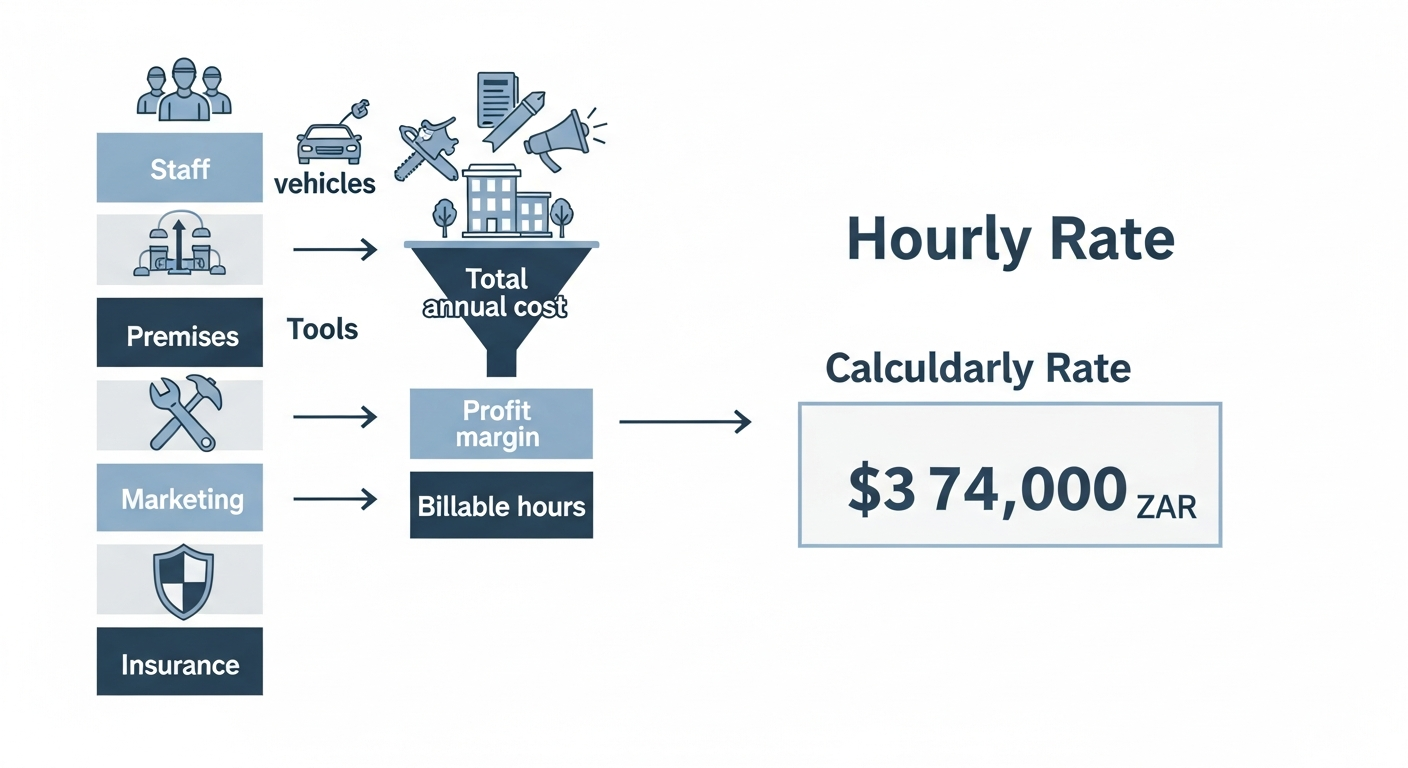
The Formula: Calculating Your Plumbing Rates Per Hour
Once you've totalled every annual cost, the formula is straightforward:
- Total Annual Cost — Sum of everything above across 12 months.
- Add your profit margin — Divide by (1 – Margin%). For a 20% margin: Annual Cost ÷ 0.80 = Required Annual Revenue.
- Calculate total billable hours — Working Days × Hours Per Day × Billable Efficiency% × Number of Teams.
- Divide — Required Annual Revenue ÷ Total Billable Hours = Your Hourly Rate (ex VAT).
Worked Example: A 3-Person Team in Johannesburg
Let's walk through a realistic scenario for a plumbing business with one team of three (qualified plumber, assistant, part-time admin allocation) operating in Johannesburg:
| Cost Category | Monthly | Annual |
|---|---|---|
| Staff (plumber R22k + assistant R11k + admin allocation R6k + statutory costs) | R46,000 | R552,000 |
| Vehicles (1 van — lease, fuel, insurance, maintenance) | R18,500 | R222,000 |
| Premises & office | R12,000 | R144,000 |
| Tools & equipment (amortised) | R4,500 | R54,000 |
| Marketing & branding | R6,000 | R72,000 |
| Software (PlumbTrack, comms) | R1,500 | R18,000 |
| Insurance (public liability, PI, all-risks) | R5,500 | R66,000 |
| Loans & debt | R3,000 | R36,000 |
| Total Annual Cost | R97,000 | R1,164,000 |
Now apply the formula:
- Annual Cost with 20% margin: R1,164,000 ÷ 0.80 = R1,455,000
- Billable hours: 230 working days × 8 hours × 55% efficiency = 1,012 billable hours
- Required hourly rate: R1,455,000 ÷ 1,012 = R1,438/hour per team (ex VAT)
Add 15% VAT and your client-facing rate is approximately R1,654/hour.
That's not a made-up number. That's the mathematical minimum you need to charge to cover costs, pay yourself, and retain a 20% margin. If your plumber call out fee in Johannesburg doesn't reflect these economics, you're working for free — or worse, at a loss.
What About a Plumber Call Out Fee in Johannesburg?
A call-out fee is not a separate concept from your hourly rate — it IS your hourly rate applied to the minimum time a job consumes. Even if you're on-site for 20 minutes, that job consumed travel time, admin time, fuel, and vehicle wear. A typical call-out fee in Johannesburg in 2026 ranges from R650 to R1,200 (VAT inclusive), which effectively covers the first hour of a team's time.
Here's how to structure it sensibly:
- Minimum charge = 1 hour at your calculated rate — This is your call-out fee. It's not arbitrary; it's the minimum billing unit that covers the real cost of dispatching a team.
- Travel beyond your service radius — Add a per-kilometre charge or a zoned surcharge. SARS's deemed rate for 2026 is a useful benchmark for mileage costs.
- After-hours and weekends — Apply a 1.5× or 2× multiplier. Your OHS Act obligations, overtime pay requirements, and call-out inconvenience all justify this.
- Emergency/burst geyser/main sewer — Premium pricing is standard. A flooded house at 22:00 is not the same job as a dripping tap at 10:00.
When you quote through PlumbTrack's document editor, your labour line items are pre-populated from your Wizard-calculated rate. You set your standard rate, your after-hours rate, and your emergency rate — and every quote and invoice pulls from those numbers automatically. No mental arithmetic, no underquoting because you forgot what you charged last time.
How PlumbTrack's Wizard Calculates Your Exact Rate
The Wizard is not a spreadsheet you download. It's not a PDF template. It's a live, interactive, 10-step guided calculator built into PlumbTrack that holds your hand through the entire process.
Here's what each step covers:
- Staff & salaries — Enter every team member. Gross salary, statutory costs.
- Vehicles & fuel — Each vehicle's full monthly cost. These auto-create stock locations (one per van).
- Premises & office — Rent, utilities, connectivity.
- Tools & equipment — Annual replacement and maintenance budget.
- Marketing & branding — Every rand you spend getting the phone to ring.
- Software subscriptions — Including PlumbTrack itself.
- Insurance — All policies relevant to your operation.
- Loans & debt — Business finance repayments.
- Efficiency settings — Working days (default 230), hours per day (default 8), billable efficiency (40–70%), number of teams, and your target profit margin.
- Results — Your required hourly rate per team, broken down clearly.
The data you enter doesn't just calculate a rate — it feeds through to other PlumbTrack modules. Staff entries sync to employee records. Vehicle entries create van stock locations. Your annual cost targets feed directly into the Incentives module, where PlumbTrack auto-calculates per-employee bonuses based on actual invoiced revenue against those targets.
Tracking Performance After You Set Your Rate
Knowing your rate is step one. Maintaining it — and improving it — is the ongoing work. PlumbTrack gives you two powerful systems for this:
The Golden Ratio Formula (GRF)
GRF scores your business from 0 to 100 across five categories and 13 individual metrics:
- Efficiency (20% of score): Jobs per week, average job duration, travel time per job
- Reliability (25%): First-time fix rate, parts availability on the van, no-show rate
- Quality (25%): Customer satisfaction ratings (1–5), PIRB/IOPSA certification score, OHS Act safety compliance
- Availability (15%): Operating hours per week, flexibility score
- Complexity (10%): Average job complexity rating
If your no-show rate exceeds 30%, your GRF score is capped at 50 — a deliberate penalty that forces you to address the problem. Similarly, if your safety compliance drops below 60, you're capped at 40. These aren't arbitrary rules; they reflect the operational realities that destroy plumbing businesses.
When your GRF shows low efficiency, you know your billable hours are down — meaning your effective hourly rate is higher than it needs to be, or you're not covering costs. That's a signal to re-run the Wizard or investigate where time is leaking.
The Incentives Module
Once your Wizard has set your cost baseline and GRF is measuring performance, the Incentives module ties it together for your team. Each technician's monthly target is derived from the Wizard's annual cost calculations. When they exceed that target based on actual invoiced labour, they earn a bonus — calculated automatically from real data, not gut feel.
Material profit is split: 50% to the team, 25% to the company, and 25% to a shrinkage reserve. Individual crediting is based on actual hours logged on each job through PlumbTrack's GPS timesheets, which track travel time and work time separately and auto-classify overtime after 40 hours per week.
The result: your team is motivated to be efficient (higher billable hours), thorough (fewer callbacks), and honest (GPS clock-in with photo capture). Your profitability improves without you micromanaging every minute.
Frequently Asked Questions
FAQ
[object Object]
[object Object]
[object Object]
[object Object]
[object Object]
Stop Guessing. Calculate Your Real Rate.
Every number in this article can be calculated for YOUR specific business in under 15 minutes using PlumbTrack's Wizard. It walks you through all 10 cost categories step by step, applies the formula automatically, and feeds your rate into your quotes, invoices, and team incentive targets. No spreadsheets. No guesswork. Just your actual number, based on your actual costs.
PlumbTrack's Wizard calculates your exact hourly rate in 10 simple steps — try it free at plumbtrack.co.za.
PlumbTrack's Wizard calculates your exact hourly rate in 10 simple steps — try it free at plumbtrack.co.za
PlumbTrack gives South African plumbers the tools to price confidently, invoice instantly, and grow their team — all in one place.