

Here's a hard truth: most plumbing businesses in South Africa are undercharging because they've never done a proper plumbing business overhead calculation. They know what they pay their staff. They roughly know what fuel costs. But when you ask them to put a number on their total cost of doing business — down to the last rand — the answer is a shrug.
That shrug is costing them their profit margin, and in some cases, it's costing them their business. If you've ever finished a month and wondered where the money went, this guide is for you. We're going to walk through every expense category, show you how they add up, and demonstrate exactly how PlumbTrack's Wizard automates the entire calculation so you never have to guess again.
What Is Overhead and Why Does Your Plumbing Business Overhead Calculation Matter?
Overhead is every cost your business incurs that isn't directly tied to a specific job's materials. It's the cost of existing as a business — the rent you pay whether you do five jobs or fifty, the insurance premiums that hit your account every month, the vehicle that depreciates while parked overnight.
It's the plumber cost of doing business that most owners dramatically underestimate.
Here's why it matters so much: your hourly rate must cover every single one of these costs plus leave room for profit. If your overhead is R85,000 per month but you're pricing jobs as though it's R50,000, you're subsidising your customers' plumbing out of your own pocket. You might be busy — fully booked, even — and still losing money.
Getting this number right is the foundation of every pricing decision you'll ever make. It determines your minimum hourly rate, your quote margins, your ability to hire, and whether your business survives a quiet month.
The Full Plumbing Business Expenses Breakdown: Every Category Explained
A thorough plumbing business expenses breakdown covers eight major categories. Miss any one of them and your hourly rate will be too low. Let's walk through each one with real South African figures for 2026.
1. Staff and Labour Costs
This is almost always your single biggest expense. It's not just salaries — it's everything attached to employing people.
- Gross salaries: A qualified plumber in Gauteng typically earns R18,000–R28,000/month in 2026. An assistant earns R8,000–R14,000/month.
- UIF contributions: 1% of each employee's salary, matched by another 1% from you as employer.
- COIDA (Workman's Comp): Assessment rates vary by risk class, but plumbing typically runs 2.5–4% of total payroll.
- Leave provision: 15 working days annual leave, plus sick leave and family responsibility leave. Budget for the days you're paying people who aren't generating revenue.
- Training and upskilling: PIRB CPD requirements, NQF progression, first aid certification renewals.
- Protective gear and uniforms: PPE, branded workwear, safety boots — typically R3,000–R6,000 per employee per year.
Example: A small plumbing business with one qualified plumber (R22,000/month), one assistant (R10,000/month), and an admin person (R15,000/month) spends R47,000/month on gross salaries alone. Add UIF, COIDA, leave provision, and PPE and you're closer to R56,000–R60,000/month on labour before anyone picks up a wrench.
In PlumbTrack's Wizard, this is Step 1. You enter each staff member with their monthly salary, and the system captures the total. These employees automatically sync to PlumbTrack's employee records, so you're not entering data twice.
2. Vehicles, Fuel, and Transport
Your bakkies and vans are the arteries of the business. They're also one of the fastest-leaking cost centres if you're not tracking carefully.
- Vehicle finance or lease payments: R6,000–R12,000/month per vehicle depending on age and model.
- Insurance: Commercial vehicle insurance runs R1,800–R3,500/month per vehicle.
- Fuel: At roughly R23–R25/litre for diesel in 2026, a plumbing van doing 3,000 km/month burns through R5,500–R7,500 in fuel alone.
- Maintenance and tyres: Services, brake pads, tyre replacements — budget R2,000–R3,500/month per vehicle as an average over time.
- Licence renewals, e-tolls, tracker subscriptions.
Two vehicles can easily cost R30,000–R45,000/month when you account for everything. The Wizard captures this at Step 2 — vehicle insurance, fuel estimates, and maintenance costs per vehicle. Each vehicle also creates a stock location in PlumbTrack's multi-location inventory system, so the stock on each van is tracked independently.
3. Premises and Office Costs
Even if you run from home, there are costs. If you rent a workshop or yard, the numbers add up fast.
- Rent or bond repayment: A small workshop/yard in an industrial area runs R8,000–R20,000/month depending on location.
- Electricity: R2,000–R5,000/month (more if you're running soldering equipment or have a geyser testing station).
- Water and rates: R800–R2,000/month.
- Internet and phone lines: Fibre + mobile contracts, R2,000–R4,000/month.
- Security: Armed response, CCTV monitoring — R1,500–R3,000/month.
Step 3 of the Wizard captures every premises cost — rent, electricity, water, connectivity, security. Owners who work from home are often surprised at how much they should be allocating for their home office, garage storage, and dedicated phone line.
4. Tools, Equipment, and Replacement
- Power tools: Drills, grinders, pipe threaders, soldering equipment. Budget for replacement cycles — most tools last 2–4 years under daily use.
- Specialist equipment: Drain cameras (R25,000–R80,000), pipe locators, pressure testers.
- Hand tools: Ongoing replacement of wrenches, cutters, spanners, levels.
- Calibration and certification: Some equipment requires annual calibration per SANS requirements.
A well-equipped plumbing team might have R150,000–R300,000 worth of tools and equipment. Spread over their useful life, that's R3,000–R8,000/month in depreciation and replacement costs. The Wizard's Step 4 lets you enter your annual spend on tools and equipment so this hidden cost is visible in your rate.
5. Marketing, Branding, Insurance, Software, and Debt
The remaining Wizard steps (5 through 8) capture costs that many plumbing business owners forget entirely:
- Marketing (Step 5): Google Ads, Facebook/Meta ads, vehicle branding, signage, business cards, directory listings. Even a modest digital marketing spend is R3,000–R10,000/month.
- Software subscriptions (Step 6): Your PlumbTrack subscription, accounting packages, cloud storage. Budget R1,000–R3,000/month.
- Insurance (Step 7): Public liability, professional indemnity, tool insurance, building insurance. R2,500–R6,000/month combined.
- Loans and debt (Step 8): Business loan repayments, credit card interest, equipment financing. Variable, but often R5,000–R15,000/month for a growing business.
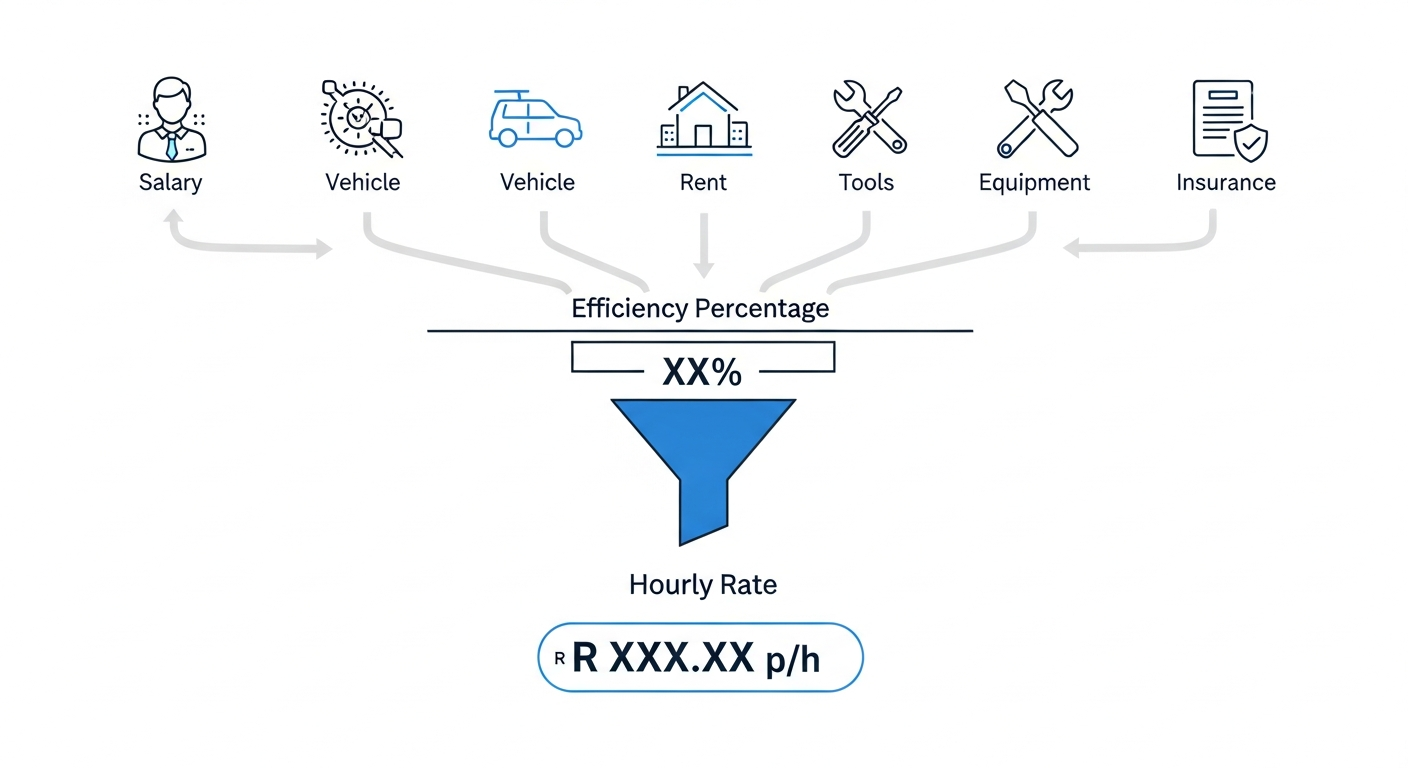
From Overhead to Hourly Rate: The Plumbing Business Overhead Calculation in Practice
Knowing your overhead total is only half the answer. The critical step is converting that number into an hourly rate that accounts for the hours you can actually bill. This is where most plumbing businesses get it catastrophically wrong.
Understanding Billable Efficiency
You might work eight hours a day, but you don't bill for eight hours. Between travel time, quoting, admin, tea breaks, callbacks, waiting for access, and stock runs, a typical South African plumbing team bills for 40–70% of their available hours. The industry average sits around 55%.
Here's what that means in practice:
- 230 working days per year (accounting for SA public holidays and annual leave)
- 8 hours per day = 1,840 total available hours per team per year
- At 55% billable efficiency = 1,012 billable hours per team per year
- That's roughly 4.4 billable hours per day — the rest is non-revenue time
Most plumbing owners assume they can bill for 6 or 7 hours a day. When reality hits at 4 to 5 hours, they've already quoted too low on hundreds of jobs.
A Real Calculation With South African Numbers
Let's walk through a complete example for a Johannesburg-based plumbing business running one team (qualified plumber + assistant) in 2026:
- Staff costs (plumber + assistant + admin allocation + statutory): R58,000
- Vehicle costs (1 van — finance, fuel, insurance, maintenance): R19,000
- Premises (small workshop, utilities, internet, security): R16,000
- Tools and equipment (depreciation + replacement): R4,500
- Marketing: R5,000
- Software: R1,500
- Insurance: R3,500
- Loan repayments: R8,000
- Total monthly overhead: R115,500
- Annual overhead: R1,386,000
Now we apply the formula that PlumbTrack's Wizard uses:
- Add your profit margin: R1,386,000 ÷ (1 – 0.20) = R1,732,500 (that's a 20% net margin)
- Calculate your billable hours: 230 days × 8 hours × 55% efficiency = 1,012 hours
- Divide: R1,732,500 ÷ 1,012 = R1,712 per hour per team
That's what this business needs to charge per billable hour — before materials — to cover every overhead cost and earn a 20% profit. If you're currently charging R650 or R800 per hour "because that's what everyone else charges," you're losing roughly R900 per hour. Every single hour.
The Hidden Costs Most Plumbers Miss in Their Overhead
Even diligent business owners miss costs that quietly erode their margins. Here are the ones we see most often when plumbing businesses first use the Wizard:
- Stock shrinkage: Fittings that walk off vans, copper offcuts that disappear, parts used on jobs but never invoiced. Industry average shrinkage in SA plumbing runs 5–12% of stock value. PlumbTrack's multi-location inventory tracks stock per van and per warehouse. The Slip Scanner lets you photograph supplier receipts, and AI extracts every line item so nothing falls through the cracks. The Incentives module even has a built-in shrinkage reserve — 25% of material profit is automatically set aside to offset losses.
- Unbilled travel time: If your team drives 45 minutes to a job and you don't charge for it, that's 1.5 hours of lost revenue per day (round trip). PlumbTrack's GPS timesheets track travel time separately from work time, so you can see exactly how much non-billable travel is eating into your day.
- Callback and warranty costs: Every return visit costs you labour hours and fuel with zero revenue. The GRF tracks your first-time fix rate — if it's below 85%, you've got a training or parts-availability problem that's silently destroying your margins.
- Admin time: Hours spent chasing invoices, doing quotes, answering the phone. If the owner spends 15 hours a week on admin instead of billing, that's 15 hours of overhead with no direct revenue. PlumbTrack's Invoice Flow kanban and one-click quote-to-invoice conversion are specifically designed to slash this time.
- Bad debt: Invoices that never get paid. If 5% of your invoices become write-offs, your effective overhead just increased by 5%.
How to Reduce Your Plumbing Business Overhead Without Cutting Corners
Once you can see your overhead clearly, you can start making intelligent decisions about where to reduce it. Not by skimping on quality — by eliminating waste and improving efficiency.
- Increase billable efficiency: Moving from 50% to 60% efficiency on our example above drops the required rate from R1,846/hour to R1,538/hour — a R308/hour difference from operational improvement alone. Smarter scheduling, better stock on vans (so techs don't make parts runs), and geographic job clustering all help. PlumbTrack's appointment calendar and live tech tracker on the dashboard make this easier to manage.
- Reduce stock shrinkage: Use PlumbTrack's stock take feature for monthly physical counts against system records. Variance reports show you exactly where stock is disappearing and from which location — warehouse or specific van.
- Improve first-time fix rate: The GRF scores this metric as part of your Reliability rating. Track it monthly. If it's below 85%, invest in diagnostic training and ensure your vans carry the right parts. The Wizard's cost data feeds into the GRF, so you can see the financial impact of operational improvements.
- Automate admin: Every hour you spend manually creating invoices, chasing payments, or reconciling bank statements is an hour you're not billing. PlumbTrack's document editor, Invoice Flow, statement generator, and bank statement AI categorisation exist specifically to compress admin time.
- Negotiate supplier terms: With PlumbTrack's inventory reporting showing your supplier spend, you have data to negotiate volume discounts or better payment terms.
Tracking Overhead Over Time: The GRF Score
Calculating your overhead once is a start. Monitoring it monthly is what separates businesses that grow from businesses that stagnate.
PlumbTrack's Golden Ratio Formula (GRF) gives you a composite performance score from 0 to 100, measured across 13 metrics in five categories: Efficiency, Reliability, Quality, Availability, and Complexity. Each metric is weighted, and the system applies automatic penalties — for example, if your no-show rate exceeds 30%, your GRF score is capped at 50 regardless of everything else.
The GRF score is directly connected to the Wizard's cost data and the Incentives module. When your team hits their GRF-derived targets, the Incentives module automatically calculates their bonus based on actual invoice performance. Labour revenue exceeding target gets credited to the team.
Material profit is split: 50% to the team, 25% to the company, and 25% to the shrinkage reserve. It's a closed loop — overhead calculation flows into performance measurement flows into fair, transparent incentive pay.
Frequently Asked Questions
FAQ
Q: What percentage of revenue should overhead be in a plumbing business? A: In a healthy SA plumbing business, total overhead (excluding job materials) typically runs 60–75% of revenue. If it's above 80%, your pricing is too low or your efficiency is too poor to sustain the business. The Wizard helps you see this number clearly by calculating the rate you need to achieve your target margin.
Q: Should I include my own salary in overhead? A: Absolutely. If you're a working owner, include a fair market salary for yourself in Step 1 of the Wizard. If you don't pay yourself properly, you're subsidising the business with unpaid labour — and you'll never know your true cost of doing business.
Q: How often should I recalculate my overhead? A: At minimum, every six months. Fuel prices, insurance premiums, and salaries change regularly in South Africa. Many PlumbTrack users revisit the Wizard quarterly, especially after salary reviews, new vehicle purchases, or rent increases.
Q: What's a realistic billable efficiency target for a SA plumbing business? A: For a single-team operation doing residential maintenance and repairs, 50–60% is realistic. Multi-team businesses with dedicated schedulers and good geographic clustering can push toward 65–70%. The GRF tracks this metric so you can measure improvement month over month.
Q: Do I include VAT in my overhead calculation? A: If you're VAT-registered (mandatory once turnover exceeds R1 million), your overhead costs are entered exclusive of VAT because you claim input VAT back. Your hourly rate from the Wizard is also ex VAT — you add 15% when invoicing the customer. PlumbTrack's invoice document editor handles VAT calculations automatically.
Know Your Numbers. Price With Confidence.
Every number in this article — the salary allocations, the vehicle costs, the billable efficiency assumptions — is unique to your business. That's why a generic industry average will never give you a rate you can trust. PlumbTrack's Wizard walks you through calculating your exact plumbing business overhead and required hourly rate in 10 simple, guided steps. You enter your real costs, set your efficiency and margin targets, and the Wizard gives you a number you can price from with absolute confidence. No spreadsheets. No formulas to build. No guesswork. Just your number, based on your business.
Open the Wizard in PlumbTrack and calculate your true hourly rate today.
PlumbTrack's Wizard calculates your exact hourly rate in 10 simple steps — no spreadsheets, no guesswork. Try it today.
PlumbTrack gives South African plumbers the tools to price confidently, invoice instantly, and grow their team — all in one place.